
HISTORY & ARCHAEOLOGY OF SUTTON PARK
The Archaeology of Sutton Park: shaped by its past
Wherever you are in Sutton Park you’ll enjoy the woods, heathland, streams, pools and wildlife that make it a National Nature Reserve. You might also know that King Henry VIII gave the Park to the town in 1528 (although he probably never came here!). And there’s far more than that. Most of Sutton Park is also a Scheduled Ancient Monument because of its well-preserved archaeological remains, which date from prehistoric times to the Second World War.
Banks, ditches, mounds and pits show how Sutton Park has been shaped by its past. The extent of Sutton Park and much of its boundary are those of a medieval deer park and its ancient woodlands follow subdivisions of the deer park. There are also even older remains, including mounds of burnt stone and charcoal dating from the Bronze Age and a well-preserved Roman road. Mill pools, targets and a racecourse remain from the Park’s more recent industrial, military and recreational use.
Protecting and explaining the Park’s past
Sutton Park’s archaeological remains are very well-preserved but they are vulnerable to irreparable damage. Unlike plants and trees, they do not regrow! FoSPA supports the History and Archaeology Taskforce (HAT), which is led by the Park Rangers. HAT protects archaeological remains by constructing dead hedges. A detailed survey of the Roman road by the University of Leicester will help to understand and protect it. It was commissioned by FoSPA with funding from Sutton Coldfield Town Council.
FoSPA organises archaeological walks and talks to explain the Park’s past. “Walking through time” was made possible by a bequest from Laurence William Loader and additional funding from Sutton Coldfield Charitable Trust and Severn Trent Water.
Our Self-Guided Walks offer the perfect opportunity to explore Sutton Park's rich history and archaeological significance. Route descriptions and maps for all six walks are available on the "Self-Guided Walks" page of our website, allowing you to discover the park's fascinating heritage at your own pace.
ARCHAEOLOGY STORIES
When you take a stroll through the woodlands, along the winding paths or sit by a pool watching the wildlife, do you ever think how they got there?
Well there are lots of stories about the people and events that have taken place in the Park and surrounding area over hundreds of years. We are sure there is a great deal more that is still to be told, meanwhile we hope these pages will help you understand a little of the past and identify some of the features that normally you would be unaware. We are grateful to Paul Crawley who provided the illustrations that help bring these stories to life.
Here you can read about Bronze Age settlers – 1330 BC, The Romans – 47 AD, The Deer Park – 1170 AD and recent industry in the Park – 1760 AD
1300 BC
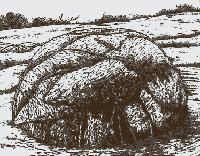
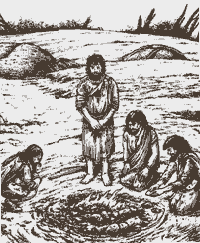
The sun is dipping below the horizon as the herdsman trudges homeward from the rough pasture with his sheep, which as usual show little inclination to keep together. Patiently he rounds up yet another stray. It will be good to reach home and get the sheep into the stockade for the night, safe from the wolves which are a constant threat. His way takes him past the clan's sweat lodge and he smiles, recalling the pleasure of relaxing a few nights ago inside the shelter of bent and woven branches covered by deer skins with the other men of the settlement. They had fetched water from the stream and poured it onto stones which had been raised to a fierce heat on a wood fire. Steam had filled the lodge and seemed to ease their aching limbs. The herdsman hopes that he can enjoy the experience again soon...
Today we can still see the 'burnt mounds' formed by piles of heat shattered stones discarded from these Bronze Age saunas, similar to used by some North American Indians. In the past it was thought they might have been cooking sites but no remains of food or cooking vessels have been found with them. The mounds are sometimes as much as 15m long but they are not obvious when they have become overgrown. Burnt mounds in eroded streams are a little easier to spot.
47 AD
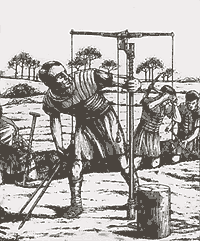
An auxiliary troper of the Roman Army - a long way from his native land - puts down his shovel and straightens his aching back. Since dawn his detachment has been digging two perfectly straight ditches eighteen metres apart. These have been marked out by the surveying officer to show the route to be followed by the legionary road to run from the fort at Metchley in Edgbaston to Letocetum (Wall).
All around him stretches barren heathland, where soon the military engineers will impose the alien line of a metalled road. The soldier has already marked several good deposits of gravel along the line of his ditch, so the engineers will have no problem finding plenty of material to make the road, a good thickness of compacted gravel, eight metres wide with a slight camber to throw off the rainwater. That should last at least twenty years, and keep Britannia pacified, he thinks...
Nearly 2000 years later, at the same spot, we can see the dead straight line of the road, which we now call Ryknield Street, with its carriageway or agger, the guide ditches dug to the surveyor's instructions, and the pits which supplied the gravel to make the agger.

1170 AD
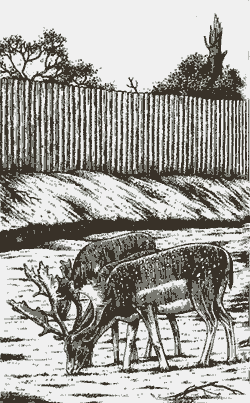
Thomas the Parker signals cautiously to his assistants. As they move forward, the herd of fallow deer stirs restlessly. At another signal from Thomas the beaters, joined by all the men from the town, drive the herd down Keepers Valley and into an enclosure. A little further on, they will be shot by archers standing on the slope above. The park is surrounded by a ditch bank and paling fence, too high for the deer to leap over. Thomas has noticed a section of broken paling, and he orders one of the servants to mend it. This reminds him of the tales told by his grandfather of the great work of making the park. All the men of the Earl of Warwick’s estates were called upon to dig a ditch four feet deep and cast up the seven-mile-long bank round the park. Now it is Thomas's responsibility to ensure that the boundary holds good well into his own grandson's time.
More than eight centuries later, extensive lengths of the banks and ditches of the deer park boundary and its subdivisions remain. A deer park was a medieval status symbol, coveted by every manorial lord. By 1300 there were deer parks at Shenstone, Hints, Drayton, Middleton and Great Barr as well as at Sutton, all within Sutton Chase. The king gave the Earl of Warwick hunting rights over this wide area. Sutton Park was originally made so that the deer could be better managed and more easily hunted than if they ran wild over the whole chase.
1760 AD
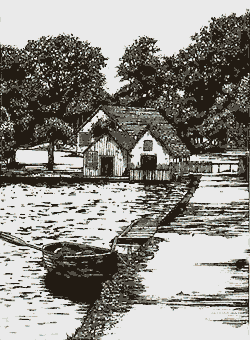
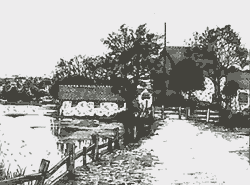
Richard Reynolds the miller stands disconsolately outside his fine new corn mill at Longmoor Pool. Everything should be going well for him, but nothing has come up to expectations. Where is the volume of trade he had confidently expected? In reality the mill is too far away from the cornfields and the pool is too small to provide a good enough sustained flow of water. Enviously he gazes in the direction of Mr. Dolphin's new mill at Blackroot Pool. What chance does Reynolds have against those wealthy gentry, Mr. Dolphin and his partner Mr. Homer? They have been able to make a much bigger pool and their mill processes leather, not corn. Reynolds makes a decision. He will ask the Warden and Society (Sutton's Corporation) for permission to convert his premises to a button-polishing mill. With luck his business will then flourish for many years to come...
Reynold's mill was demolished in 1938. It was only one of a dozen watermills carrying out industrial processes at various times in Sutton Coldfield. Today the tranquil pools at Longmoor and Blackroot show no trace of their industrial origins.
Copyright All Rights Reserved © 2026 - FoSPA - Our PRIVACY POLICY